Curriculum guide
What your child learns in eighth grade
Explore everything your Pre-K child will experience throughout the year, from early reading and math to faith, art, and friendship, all through hands-on, play-based learning.
Religion
Your child will:
- Examine Catholic moral teaching through study of the Ten Commandments
- Connect Catholicism to world religions
- Research and present the life of a saint to the school community
- Model the social teaching of the Church through service in the local community
- Show faith and service through participation and leadership in school Masses and prayer services
Literature
Your child will develop reading comprehension and analysis by:
- Building vocabulary
- Learning important literary elements and devices
- Using effective reading strategies
- Reading, applying, analyzing, and evaluating fiction and nonfiction texts
- Communicating ideas clearly in conversation and in writing
History
Your child will explore the themes of democracy, liberty, equality, and foreign policy in American history by:
- Reading and analyzing primary sources
- Interpreting maps and charts
- Studying events such as the American Revolution, the Constitutional Convention, the Civil War, Reconstruction, World War II, the Civil Rights Movement, the Cold War, September 11th, and the War on Terror
- Learning the principles of American democracy and other governmental and economic systems
- Developing historical thinking skills: sourcing, chronological and causal thinking, multiple perspectives, and corroboration
- Connecting past events to the present in group conversations
- Practicing good citizenship skills
Language Arts
Your child will:
- Write clearly and effectively
- Use the six-trait writing techniques: ideas, organization, sentence fluency, word choice, voice, and conventions
- Write in a variety of forms, including descriptive, expository, creative, persuasive, and research papers
- Use the writing process: pre-writing, drafting, revising, editing, and publishing
- Analyze and evaluate the effectiveness of written work
- Learn and apply correct grammar, sentence structure, punctuation, and capitalization
- Identify and use clauses and phrases
- Complete a spelling program
Spelling
Your child will:
- Follow a spelling program
- Use spell check
- Spell words correctly on final drafts
Social Studies
Your child will:
- Connect with world events and the present
- Note the impact of historical events
- Understand the diverse cultural makeup of America
- Identify how U.S. history is reflected in stories, songs, and poems
- Learn basic map skills
- Explore the impact of geography on people's lives
- Analyze primary sources
- Practice citizenship skills
- Work with charts and graphs
Math: Pre-Algebra and Algebra
In Pre-Algebra your child will:
- Explore the language of algebra
- Add, subtract, multiply, and divide integers and fractions
- Solve and simplify expressions using the Distributive, Commutative, and Associative Properties
- Write and solve multi-step equations and inequalities
- Multiply and divide monomials
- Evaluate expressions with ratios, proportions, and percents
- Graph linear equations and inequalities
- Apply geometry to real-world problems
In Algebra your child will:
- Communicate in the language of algebra
- Write and solve multi-step linear equations and inequalities
- Graph functions, linear equations, and inequalities
- Develop and solve systems of linear equations
- Add, subtract, multiply, and divide monomials and polynomials
- Factor polynomials
- Graph and solve quadratic equations and exponential functions
- Apply geometry to real-world problems
Science: Earth Science
Your child will:
- Practice laboratory safety
- Use the scientific method in problem solving and conduct independent projects using controls and variables
- Use and convert between SI (metric) units
- Understand how minerals form rock and how rock types convert through the rock cycle
- Recognize the tectonic, seismic, and volcanic forces that shape Earth
- Understand the properties of ocean water and the interaction between ocean and atmosphere
- Understand atmospheric and weather phenomena as they relate to the water cycle
- Observe the night sky and learn current theories on the formation of the solar system and universe
Art
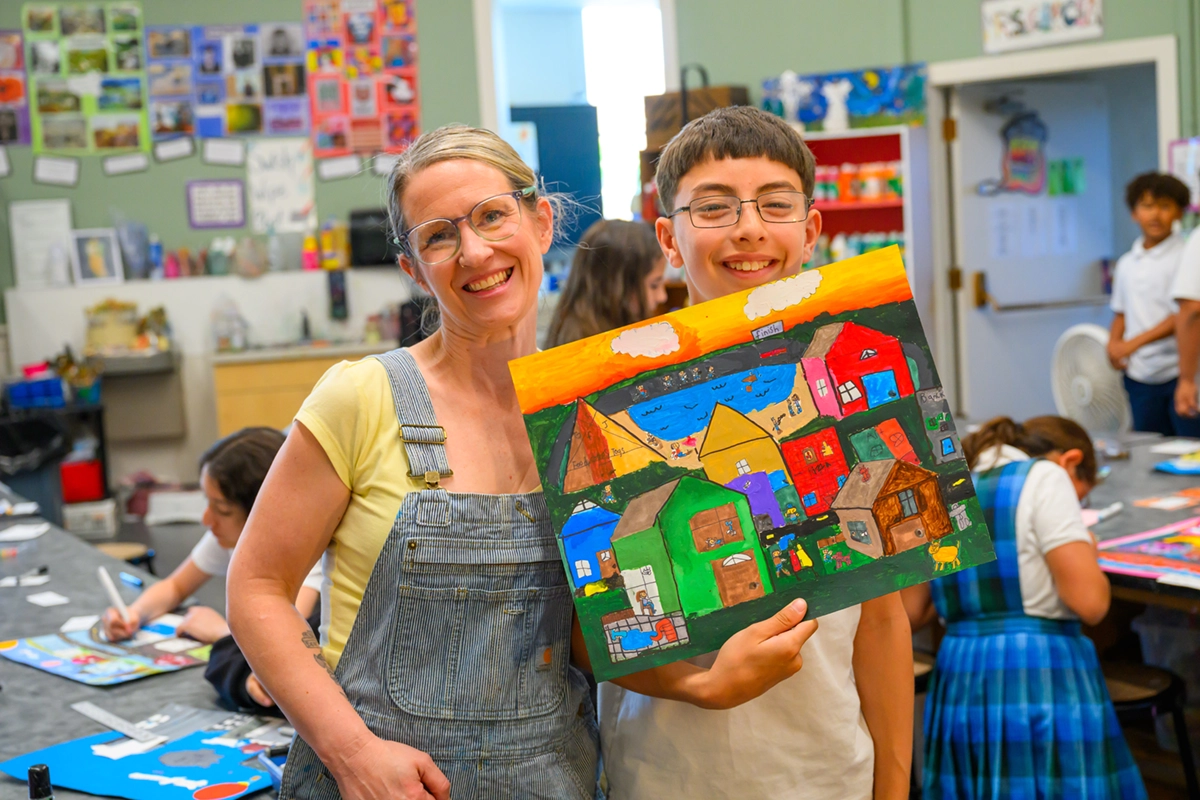
Each student has one quarter of art and produces items for public display, with a focus on sculpting and painting portraits. Your child is introduced to pop and modern art, digital photography, computer graphics and graphic design, modeling clay, advanced painting techniques, and how to produce and display work.
Physical Education
Each student has two quarters of P.E. with their homeroom and changes into P.E. clothes for health and hygiene. Students participate at their current skill level, show growth, and practice good sportsmanship.
Music and Drama
Students have one quarter of music and drama focused on vocal music and theater. They improve their vocal technique, broaden their knowledge of the crafts of theater, and present a singing-and-drama performance at the end of the quarter.
Computer Technology
Students use classroom computers for many projects, typically using PowerPoint, word processing, the internet, and other media resources.
Questions? Call the school
We'd love to answer your questions and help you learn more about St. Joseph Marquette.